
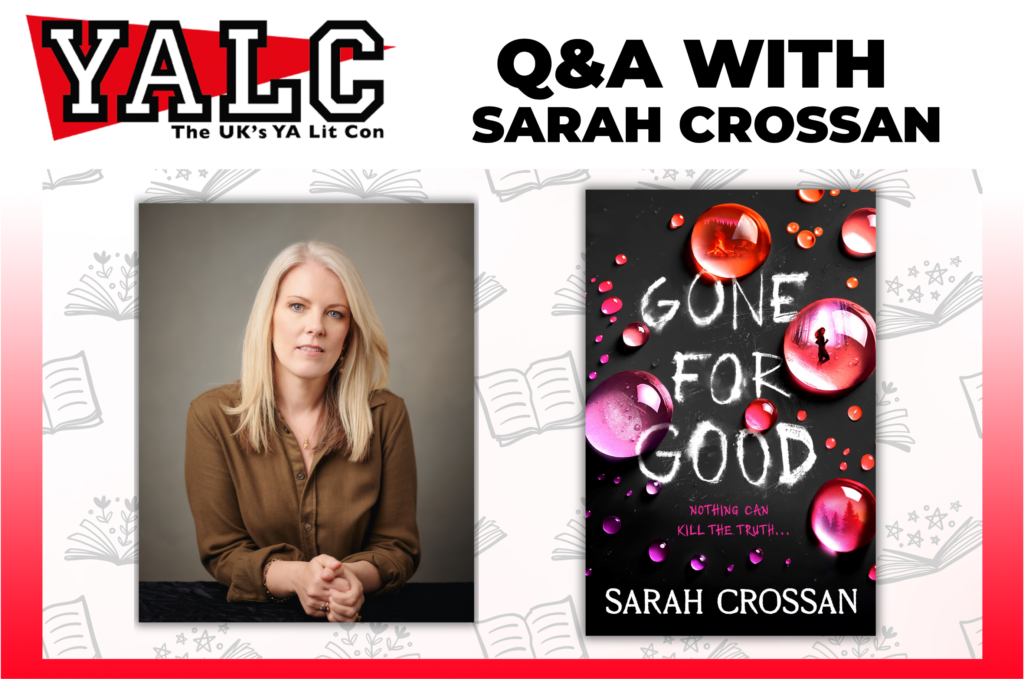
– Thank you for joining us here at YALC. We would love you to introduce yourself.
Hey there, I’m Sarah Crossan. I’ve written loads of books, but I always come back to writing YA novels in verse. I don’t drink coffee. I do drink tea. I like outrageously expensive notebooks and cheap pens.
– Can you give our readers an overview of your novel Gone for Good?
Gone for Good is a missing girl whodunit set in a forest in Upstate New York. It’s also set in a behavioural modification programme or the ‘troubled teen’ industry. Our protagonist, Connie Ryder, arrives at Silver Lake Academy after having been kidnapped from her bed and realises the girl who used to sleep in her bed , Belle Jackson, is missing. If she doesn’t want to end up missing herself, she needs to find out what happened to Belle.
– If you could do it in just 5 words or less, what would they be?
Pacy and poetic.
– What inspired you to write Gone for Good?
A documentary about the troubled teen industry. It’s always a documentary for me! Plus, I wanted to see if I could write a thriller in verse. It was a secret challenge to myself.
– What drew you to explore the themes of loss and grief?
I have always explored loss and grief. Grief is everywhere. Nothing can prepare you for it and nothing can save you from it. I lost my parents a few years ago and this also had an influence on what I was writing.
– Are any characters based on real people or experiences?
I can’t reveal my sources! But Connie is called Connie Ryder because my daughter loves Winona Ryder, I’ll give you that!
– Did you face any challenges while writing Gone for Good?
I didn’t know if I could fit the layers and plot of a thriller into a verse novel. I had to squish so much stuff into so few words. I doubted I would manage it. But I did it! I used the delete key on my laptop a lot.
– What role does verse play in your storytelling?
I love verse. If you know me, you know this. I like the immediacy of it. I like the brevity.
– What draws you to writing in verse?
Ultimately I can skip all the boring bits of a book and focus on the emotional nucleus of the story.
– How do you decide where to break lines and structure of the verse within the novel?
Each break has its own reason and there are too many to list her, but sometimes I’ll break a line, for example, when I’d like the reader to pause for a nanosecond to inhale the words or reflect.
– Do you develop your story first, or does the poetic form influence the story?
Usually neither, it’s a character who leads the charge. But with Gone for Good it was the story that came first, the idea of a thriller set at a troubled teen camp. So I knew what the plot would be before I began writing – everything was mapped out. This was unlike any other time I’d written, and it was a liberating experience.
– What do you want readers to take away from Gone for Good?
Every reader will find something different. I wouldn’t be a good writer if everyone came away with the same experience.
– Where do you write?
At home in my office or in local coffee places. I mix it up. I can’t work when I’m not dressed though, so never in bed or in PJs. I have my lipstick and perfume on, always.
– What is your favourite genre to read?
I don’t have a favourite. I like thrillers and contemporary verse novels and literary fiction and historical and memoirs. It depends on my mood.
– Where can our readers find you on socials?
I’m on Instagram, but I’d prefer if people read/cook/walk/paint/eat rather than look for me online! Let’s get off our phones whenever possible.
– Finally, can you give us your favourite quote from a novel (it can be yours!)?
It’s too hard to pick a favourite. But I love the line, ‘I don’t exactly know what I mean by that, but I mean it.’ from Catcher in the Rye. Such a funny novel.
GONE FOR GOOD by Sarah Crossan is out now (Simon & Schuster, PB £9.99). It has been chosen as the Waterstones YA Book of the Month for March.